Navigating Cross-Border Data Protocols and Their Effects on Verification Timelines for Multi-State Wagering Networks
Written by Anna Neumann · Jun 8, 2026
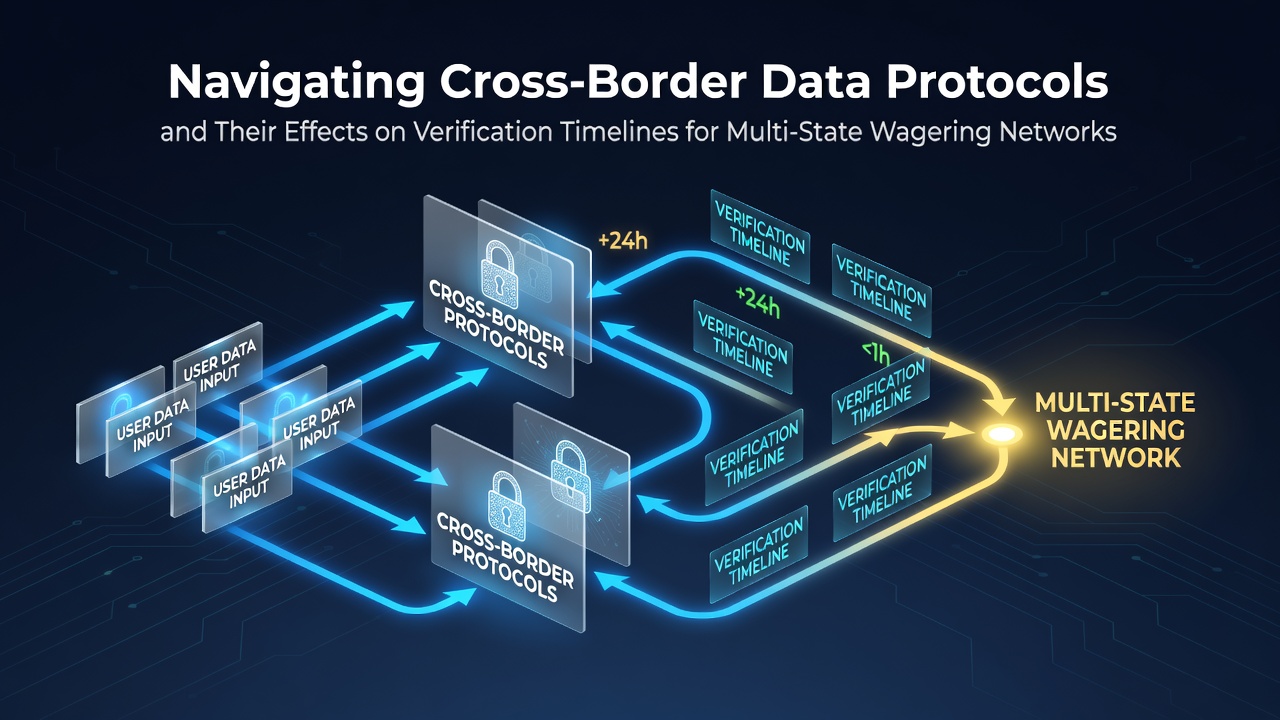
Navigating Cross-Border Data Protocols and Their Effects on Verification Timelines for Multi-State Wagering Networks
Multi-state wagering networks operate across jurisdictions where data protocols govern how personal information moves between operators and regulators, and these rules directly shape the speed of user verification processes. Operators must align with varying state requirements for data storage, transfer consent, and security standards while completing identity checks that include age confirmation, payment validation, and location tracking. Research from the University of Nevada, Las Vegas shows that compliance layers add sequential review steps that extend average verification windows from hours in single-state setups to multiple days when networks span four or more jurisdictions.
Data localization mandates require certain records to remain within state boundaries, which forces operators to route verification requests through separate servers rather than centralized systems. This segmentation creates bottlenecks because each location performs its own compliance scan before forwarding partial results to the next checkpoint. Figures from the National Association of Attorneys General indicate that networks handling cross-state traffic in 2025 experienced verification delays averaging 47 hours longer than intra-state counterparts, with the gap widening when additional privacy consents must be collected at every border crossing.
Core Elements of Cross-Border Protocols
Protocols typically combine encryption standards, consent management platforms, and audit logging that track every data packet crossing state lines. While encryption protects sensitive details during transit, it also requires decryption and re-encryption at each jurisdictional handoff, extending processing sequences. Consent management tools collect and store user permissions according to the strictest applicable rule set, yet reconciling differing definitions of explicit consent across states demands extra validation rounds that slow initial account approvals.
Audit logging adds another dimension because regulators in each participating state may demand real-time or near-real-time access to logs. Operators therefore build parallel logging pipelines that duplicate data streams, and synchronization between those pipelines consumes additional computational resources that delay the final verification signal sent back to the user. In June 2026, several networks reported that new logging synchronization requirements implemented in early spring contributed to a measurable uptick in average verification completion times.
Measured Effects on Verification Timelines
Verification timelines expand most noticeably during peak registration periods when thousands of simultaneous requests compete for limited compliance review capacity. Networks that previously completed checks within 90 minutes now allocate up to six hours for the same volume once cross-border routing is factored in. Payment verification compounds the issue because financial institutions in different states apply their own fraud screening rules that must be reconciled with wagering-specific requirements before funds can be accepted.

Geo-location services add further complexity because continuous location confirmation must occur without storing prohibited data types in restricted jurisdictions. Operators therefore implement token-based location proofs that expire quickly, requiring fresh tokens for each verification milestone. This token refresh cycle inserts additional API calls that accumulate into measurable time increases, especially when one state’s token format must be translated for acceptance by another state’s system. Data collected by the Competition Bureau of Canada on similar cross-jurisdictional systems in regulated gaming markets demonstrates that translation layers alone can add between 12 and 18 minutes per verification event when formats diverge significantly.
Regulatory Developments and Industry Responses
State legislatures continue to refine data-sharing agreements that aim to reduce duplication while preserving each jurisdiction’s oversight authority. Several compacts signed in late 2025 introduced standardized verification data templates that allow a single set of core identity documents to satisfy multiple states simultaneously, provided the data remains encrypted under a mutually recognized protocol. Early adoption of these templates has shortened verification paths in participating networks by removing redundant document uploads, although full rollout across all multi-state operators remains incomplete as of June 2026.
Operators have responded by investing in modular compliance architectures that isolate state-specific rules within plug-in components. These architectures permit rapid updates when one jurisdiction revises its protocol without forcing a complete system rebuild. Industry reports note that networks employing modular designs reduced their average verification extension from 47 hours to 29 hours within six months of implementation, illustrating how technical choices can mitigate protocol friction.
Conclusion
Cross-border data protocols continue to influence verification timelines by introducing sequential compliance steps, localization requirements, and logging obligations that accumulate across state lines. Networks that adopt standardized templates and modular architectures demonstrate measurable reductions in processing delays, while those relying on legacy centralized systems face sustained extensions. As additional states finalize data-sharing agreements, verification performance will depend on how effectively operators integrate new protocol requirements into existing workflows without creating fresh bottlenecks.